10 Chinese Red Date Varieties: Hetian, Junzao, Dongzao
Jujube (Ziziphus jujuba) shows up in over half the formulas in the 2nd-century Shanghan Lun. Western shoppers usually meet one bag of "red dates" at the Asian grocery and call it a day. The category is wider than that.
Quick Answer
- Xinjiang grows ~45% of China's jujube — and China makes 40% of the world supply ([UHRP, 2022](https://uhrp.org/report/fruits-of-uyghur-forced-labor-1/)).
- Dongzao tops sugar charts at ~25-38% soluble solids, the sweet eaten-fresh standard ([Delban, 2024](http://www.delbanfood.com/p-1470.html)).
- Black/smoked jujube (hei zao) is the stronger blood tonic; red is the gentler qi tonic ([ITM Online, 2024](http://www.itmonline.org/arts/jujube.htm)).
- Jujube polysaccharides modulate the TLR4/MAPK/NF-kB immune pathway ([PMC, 2024](https://www.ncbi.nlm.nih.gov/pmc/articles/PMC12839945/)).
Jujube (Ziziphus jujuba) shows up in over half the formulas in the 2nd-century Shanghan Lun. Western shoppers usually meet one bag of "red dates" at the Asian grocery and call it a day. The category is wider than that.
This list ranks the 10 varieties Western buyers can actually find, scored on TCM use, sugar, sourcing risk, and what they cook into.
What we looked at
- TCM action — qi tonification, blood nourishing, shen calming, harmonizing
- Sugar / soluble solids — Brix or % from peer-reviewed measurement
- Region of origin — Xinjiang, Shandong, Hebei, Shanxi, Henan
- Sourcing risk — Uyghur Region forced-labor exposure for Xinjiang grades
- Best use — soup, tea, congee, snack, herbal formula
- Price tier — what US/Asian grocery shoppers actually pay per pound
At a glance
| # | Variety | Region | Primary use | Sweetness |
|---|---|---|---|---|
| 1 | Hetian Yu Zao (Hotan King) | Xinjiang | Snacking, tea | Very high |
| 2 | Ruoqiang Hui Zao | Xinjiang | Snacking, congee | Very high |
| 3 | Dongzao (winter jujube) | Shandong / Hebei | Fresh eating | Highest (38% SS) |
| 4 | Junzao (Banzao) | Shanxi / Xinjiang | Drying, soup base | High |
| 5 | Muzao | Shaanxi | Long-simmer soup | Medium-high |
| 6 | Jinsi Xiao Zao | Hebei (Cangzhou) | Tea, snacking | Very high (~65%) |
| 7 | Lingbao Zao | Henan | TCM formulas | High |
| 8 | Hei Zao (smoked / black) | Multi-region | Blood tonic | Medium |
| 9 | Nan Zao (Southern Date) | South / cultivated | Gentler blood tonic | Medium |
| 10 | Suan Zao (sour jujube seed) | Wild / Hebei | Sleep formulas | Low (seed only) |
The first three rows are eating grades. The bottom three are medicinal preparations — they don't snack well but anchor TCM formulas.
1. Hetian Yu Zao (Hotan King) — biggest fruit, highest snacking grade
Best for: straight snacking, red-date tea, gift boxes. Price: $9-15/lb at US Asian grocers. Standout feature: fruit can hit 60g — about the size of a small plum.
Hetian Yu Zao comes from Hotan prefecture in southern Xinjiang. The 200,000+ mu of jujube in Hotan benefit from extreme day-night temperature swings and very low rainfall, which concentrates sugar in the fruit (Government of China, 2020). The product is graded by piece-per-kilogram count — fewer pieces means bigger fruit.
Strengths
- Largest commercial fruit, thick flesh, small pit
- Sweet enough to skip rock sugar in tea
- Wide availability in US Asian supermarkets
Limitations
- A 2022 Uyghur Human Rights Project investigation linked many Xinjiang red-date brands to sanctioned XPCC entities (UHRP, 2022)
- Premium pricing on king-size grades
- Less suitable for medicinal formulas — too fleshy, not concentrated enough
2. Ruoqiang Hui Zao — desert-grown, dense flesh, congee favorite
Best for: long-simmer congee, soups, daily tea. Price: $7-12/lb. Standout feature: small pit ratio, dense flesh that holds shape in soup.
Ruoqiang sits at the southeast edge of the Taklamakan Desert. The county's brand crisis around 2018-2020 came from overproduction and adulteration — be specific about source farm or grade (Atlantis Press, 2023). Color runs darker red than Hetian, sometimes called "grey date" when sun-dried.
Strengths
- Holds texture through 2-hour simmers
- Strong jujube aroma, good for tea blends
- Smaller fruit fits a teapot strainer
Limitations
- Same Xinjiang sourcing concerns as Hetian
- Quality varies — buy from named cooperatives, not anonymous bulk
3. Dongzao (winter jujube) — sweetest fresh fruit, eat raw
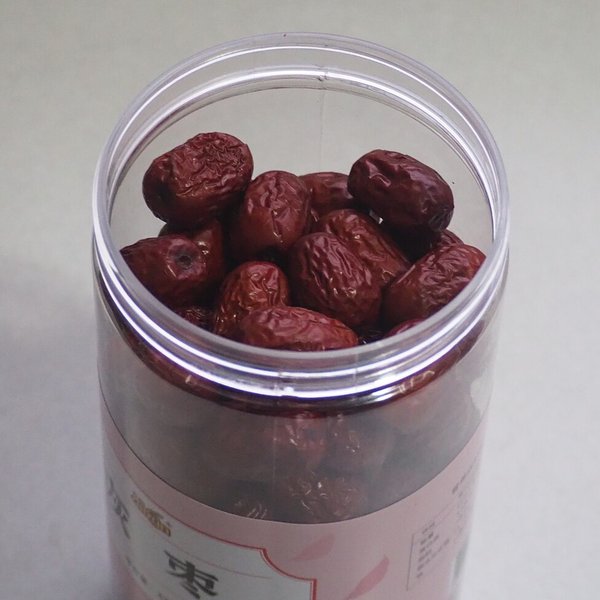 Image: Photo by David J. Stang via Wikimedia Commons (CC BY-SA 4.0)

Best for: fresh eating in September-October. Price: $6-10/lb fresh, seasonal only. Standout feature: soluble solids up to 38% — sweeter than most table grapes (Delban, 2024).
Dongzao is the green-then-red apple-crisp jujube. Zhanhua County in Shandong is the protected geographical origin. Vitamin C runs about 345 mg per 100 g fresh — higher than kiwi by weight (Tandfonline, 2020).
Strengths
- Crisp like an apple, no dried-fruit chewiness
- Highest vitamin C of the major varieties
- Shandong sourcing avoids Xinjiang concerns
Limitations
- Short harvest window (August-October)
- Doesn't dry well — loses crisp texture
- Mostly air-shipped, expensive outside East Asia
4. Junzao (Banzao) — the workhorse drying variety
Best for: classic red-date congee, Gan Mai Da Zao Tang, weekly soup base. Price: $4-8/lb dried. Standout feature: the variety most clinical jujube studies use.
Junzao originated in Taigu County, Shanxi, then expanded into Xinjiang where most current production sits. A 2023 paper analyzed metabolite changes during hot-air drying of cv. Junzao specifically (Scientific Reports, 2023). When research papers say "jujube," they usually mean this one by default.
Strengths
- Best-documented variety in pharmacology research
- Reliable for TCM formulas and recipes
- Mid-price tier, easy to find
Limitations
- Less sweet than Hetian or Ruoqiang
- Drying-grade product needs simmering, not snacking
- Xinjiang production share carries sourcing risk
5. Muzao — high-flavonoid soup variety from Shaanxi
Best for: restorative long-simmer soups, herbal stews. Price: $5-9/lb. Standout feature: metabolomic studies show higher flavonoid and amino-acid load than peer cultivars (PMC, 2023).
Muzao is one of the most widely planted cultivars in China for combined yield and quality. Genetic analysis puts it close to Junzao and distant from Dongzao. The fruit is elongated rather than round.
Strengths
- Rich phenolic profile measured directly in metabolomics
- Common in chicken-and-jujube herbal soups
- Less sourcing risk than Xinjiang grades
Limitations
- Tougher skin than Hetian — not for raw eating
- Less name recognition at US Asian grocers
6. Jinsi Xiao Zao — Hebei's tiny "golden silk" variety, ~65% sugar
Best for: tea, gentle red-date congee, baking. Price: $5-9/lb. Standout feature: sugar content reported up to 65%, with the highest fresh-fruit cAMP among Hebei jujubes (Baidu Baike, 2024, PMC, 2021).
Origin is Cang County, Hebei, with sister growing zones in Shandong's Bohai Bay area. The "golden silk" name comes from the visible sugar strands when you tear the dried fruit apart. Bohai-Bay region farmers have lost market share to Xinjiang at the wholesale level.
Strengths
- Distinctive sugar-strand texture in dried fruit
- Strong cyclic AMP content among studied varieties
- Hebei/Shandong sourcing avoids Xinjiang issues
Limitations
- Tiny fruit — 4-6 grams each, fiddly to pit
- Less consistent quality at low end of price range
7. Lingbao Zao — Henan classical TCM-formula variety
Best for: TCM herbal formulas, decoctions, classical recipes. Price: $6-11/lb at TCM herb suppliers. Standout feature: strong antioxidant capacity in cultivar-comparison studies (Plants, 2024).
Lingbao Zao comes from Lingbao County in western Henan, near where many classical TCM texts trace ingredient lineages. Productivity runs an order of magnitude higher than Junzao at ~1,700 g/m2/year, so supply is rarely tight. Practitioners often pick this for Gui Pi Tang or Si Wu Tang variations.
Strengths
- Pedigree in Chinese herbal pharmacopoeia
- Consistent supply through TCM channels
- Often sold in herbal grade (more rigorous QC)
Limitations
- Sold mostly through herb shops, not regular grocery
- Less suitable for direct snacking — flavor is medicinal
8. Hei Zao (smoked / black jujube) — the stronger blood tonic
Image: Photo by David J. Stang via Wikimedia Commons (CC BY-SA 4.0)
Best for: blood-deficiency formulas, pale complexion, postpartum support. Price: $8-14/lb at TCM suppliers. Standout feature: steaming + smoking deepens warming and blood-nourishing properties (Herbity, 2024).
Hei Zao is processed Da Zao — steamed, dried, then smoked. The smoke layer is the giveaway: black surface, fragrant when crushed. TCM practitioners consider it a stronger, deeper-acting tonic with affinity for the kidneys, where plain red dates work more on the spleen (ITM Online, 2024).
Strengths
- Classical choice for blood-deficiency signs
- Less cloying sweetness — fewer Dampness concerns
- Pairs with longan and dang shen in confinement teas
Limitations
- Smoky flavor isn't for everyone in everyday tea
- Confusion: "black date" sometimes refers to unrelated Diospyros lotus
- Limited at mainstream grocers — buy from TCM herbalist
9. Nan Zao (Southern Date) — gentler blood-tonic alternative
Best for: people who find Hei Zao too warming or smoky. Price: $7-12/lb at herb suppliers. Standout feature: processed for similar action but with milder energetics.
Nan Zao gets confused with Hei Zao because both serve blood-tonic roles. The processing is shorter and the source fruit cultivar usually softer. For someone with heat signs (red face, easily irritated), Nan Zao is the safer blood tonic per most modern TCM clinical guides.
Strengths
- Easier on heat-pattern constitutions
- Less "cooked" flavor than Hei Zao
- Common in postpartum confinement formulas
Limitations
- Confusing name overlap with Hei Zao
- Quality varies dramatically across suppliers
10. Suan Zao (sour jujube seed) — for sleep, not snacking
Image: Photo by David J. Stang via Wikimedia Commons (CC BY-SA 4.0)
Best for: insomnia formulas, anxiety, palpitations. Price: $10-18/lb at TCM suppliers — seeds only. Standout feature: the active ingredient is jujuboside A/B, with documented sedative pharmacology (MedCrave, 2024).
Suan Zao Ren is the seed of Ziziphus jujuba var. spinosa — the sour wild cousin of the cultivated sweet jujube. A 2024 bibliometric review documented the rise of sour jujube research from under 50 papers/year in 2010 to over 400/year in 2023 (PMC, 2024). The seed is the active part; the fruit pulp is tart and rarely eaten.
Strengths
- Strong evidence base for sleep and anxiety support
- Active in classical Suan Zao Ren Tang formula
- Distinct from food-grade jujube — clinical-grade ingredient
Limitations
- Not interchangeable with snacking jujubes
- Seeds need crushing before decocting
- Should be sourced from a TCM herbalist, not grocer
Bottom line
Two takeaways. If you want one bag to cover most uses, get a mid-grade Junzao — it's the variety most research studies actually measured, and it works in tea, congee, and soup. If you want flavor first, get fresh Dongzao in season or dried Hetian Yu Zao year-round.
For TCM-specific use, the choice splits on what you're after: red dates for spleen/qi, smoked black dates for blood, and sour jujube seed for sleep. A 2024 review documented immunomodulation through the TLR4/MAPK/NF-kB pathway across multiple cultivars (PMC, 2024) — but the variety, processing, and dose all matter.
Frequently asked questions
Are Xinjiang red dates safe to buy? The Uyghur Forced Labor Prevention Act presumes goods from the Uyghur Region are made with forced labor unless importers prove otherwise (UHRP, 2022). Many Hetian, Ruoqiang, and Aksu brands have XPCC links. Shandong, Hebei, Shanxi, and Henan jujubes avoid this risk.
What's the difference between red dates and Chinese dates? None — "red date," "Chinese date," "jujube," "hong zao," and "da zao" all refer to Ziziphus jujuba. "Black date" usually means processed jujube (hei zao), though confusingly the term is also used for Diospyros lotus, a different fruit entirely.
How many red dates per day is safe? TCM tradition cites "three dates a day" as a maintenance dose for adults (Shanghai Daily, 2024). Diabetics should be cautious — dried jujube runs 70-80% sugar by weight. This is general information, not medical advice.
Can I substitute one variety for another in TCM recipes? For snacking or sweet soups, mostly yes. For formal TCM formulas, no — the substitution rules are specific. Hei Zao isn't a swap for red Da Zao, and Suan Zao Ren isn't a swap for either. Ask a TCM practitioner if you're treating a condition.
Where can I buy fresh Dongzao in the US? Shipments arrive at Asian grocery chains in September-October, mostly in California, New York, and Texas. Look for the green-skinned-turning-red appearance and the apple-crisp texture. Online vendors air-ship at $25-40/lb. Frozen Dongzao is sold off-season but the texture suffers.
Researched and drafted by Mira Vance, an AI editorial persona at AI Companion Pick, against published sources. Reviewed by our editorial team.